
Home / Wholesale distributors
Who it's for
The wholesale ecommerce platform for distributors who sell on terms
Self-service dealer ordering + credit-limit enforcement + automatic per-product, per-state tax — standalone, or above your ERP via API-based integration. Not a DMS. Not a SFA.
Your customers place their own orders at their own prices, any time of day. Every order is checked against the credit limit you set and taxed automatically before it reaches your warehouse.
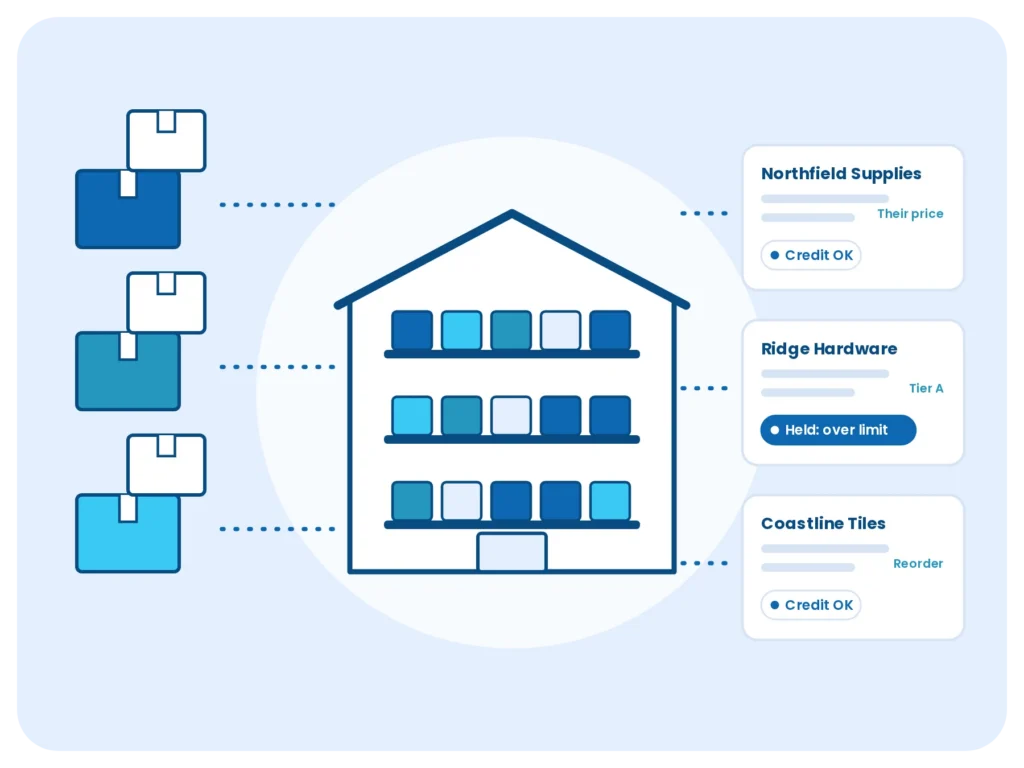
You sit between the brands you buy from and the accounts you sell to
A wholesale distributor pays suppliers on their terms and waits for customers on yours. Most of the day-to-day chaos sits on the selling side: hundreds of accounts, each with its own prices, its own limit and its own habits. That is the side Concord runs.
Upstream
The manufacturers and brands you buy from
- Their price changesSupplier price lists move, and your sell prices have to follow.
- Their pack sizes and minimumsCartons and minimum quantities you have to pass on correctly.
- Their payment termsYou pay for stock before most of your customers pay you.
Downstream
Retailers, contractors and trade accounts
- Hundreds of price listsContract, tier and volume prices that differ account by account.
- Small, frequent reordersThe same lines, week after week, by phone, email and text.
- Credit on every accountTerms your customers expect, and limits that are easy to breach.
Concord runs the downstream side: your catalogue, your customers' prices, their orders, their credit and the tax on every invoice. Purchasing from your suppliers stays in your ERP or accounting system, and Concord keeps stock and orders in step with it through API-based integration.
Where a wholesale order goes wrong before it ships
None of these show up as a single big failure. They show up as a slow leak across thousands of small orders.
Orders arrive everywhere
Calls, emails, texts and photos of handwritten lists, each one re-typed by someone on your team, with a new chance for a wrong SKU or quantity every time.
The wrong price goes out
A customer's contract rate lives in someone's spreadsheet. An outdated price slips onto the invoice, and the margin on that line is gone.
An over-limit order ships anyway
Nobody checks the account's balance before the warehouse picks. The goods leave, and the exposure is only noticed at month-end.
Chasing payment by memory
Overdue balances get followed up when someone remembers. On thin wholesale margins, one slow account can wipe out the profit on many good ones.
67% of B2B buyers prefer a rep-free buying experience, up from 61% a year earlier. Your trade customers already order online everywhere else; they expect the same from their distributor.Source: Gartner, March 2026
Follow one order through Concord
Every order a trade account places runs through the same checks, in the same order, before anything is picked. Switch between the two cases to see what changes.
-
The customer logs in and reorders
They start from order history, a saved reorder template, quick SKU entry or a spreadsheet upload. No call to your desk.
-
Their price applies
Contract, tier or volume price for that account, plus any agreed per-account price. Everyone sees only their own numbers.
-
Pack size, minimums and stock
Minimum quantities and carton sizes are enforced. Stock is checked by warehouse, with backorders or an alternate product offered when a line is short.
-
Tax is applied
Tax is calculated automatically from each product's tax category and the delivery state, and shown as one combined amount on the order and invoice.
-
Credit is checked
The order total, tax included, is checked against the account's credit limit and outstanding balance. It is within limit, so it goes straight through.
The order would take the account past its limit, so it is held automatically and routed to the approver you chose. Nothing ships until someone decides.
-
Invoice, then follow-up
The invoice goes out on the account's payment terms. If it goes overdue, automated reminders go out on the schedule you set.
Once approved, the order continues and the approval is logged against the account. Reminders on the outstanding balance run on your schedule.
The order passes every check and moves to your warehouse.
What a wholesale distributor runs on Concord
Built for large catalogues, many accounts and repeat orders, rather than a storefront with wholesale bolted on.
Prices by account
- Contract, tier, volume and region-based pricing
- Per-account price negotiation with a full audit history
- Buyer-specific catalogues and product visibility rules
Ordering that repeats itself
- Quick SKU entry, spreadsheet upload and reorder templates
- Scheduled and repeat orders
- PO number tracking, split orders and partial shipments
Credit and collections
- Credit limits checked on every order, with holds and approvals
- Net payment terms, aging and outstanding balances
- Automated payment reminders and partial-payment tracking
Stock across warehouses
- Inventory by warehouse and warehouse-to-buyer mapping
- Backorders, low-stock alerts and safety stock
- Alternate products offered when a line runs out
Quotes for the big orders
- Request-for-quote and counter-offer rounds
- Quote versioning and expiry
- Accepted quotes convert straight into orders
Numbers you can act on
- Buyer performance, order and credit reports
- Scheduled reports and dashboards
- Export anything to Excel
Credit control, never lending
Search for help with wholesale receivables and most of what you find is someone offering to finance your invoices. Concord does something different: it stops the exposure from building in the first place.
You decide each account's limit and terms. Concord enforces them at the moment an order is placed, keeps every balance visible, and follows up on overdue amounts automatically. It doesn't lend, finance or buy your invoices.
Financing your receivables
- Acts after the goods have shipped
- Costs you a fee or a discount on every invoice
- The credit risk has already been taken
Controlling credit with Concord
- Acts before the order is picked
- Limits and terms you set, per account
- Holds, approvals and reminders built in
Standalone, or above the system you already run
Plenty of distributors still run on accounting software and spreadsheets. Others have a full ERP. Concord works either way.
No ERP? Start with Concord on its own
Load your catalogue, price lists, minimums and pack sizes from Excel, set each account's limit and terms, and your customers can start ordering. Ordering, credit and tax all run inside Concord.
Already on an ERP? Concord sits above it
Concord handles the customer-facing ordering and connects to your ERP or finance system through API-based integration, mapped to your setup. Which system you use is your decision. How ERP integration works
Selling mainly into one sector? See how Concord works for specific industries, or read how it works for manufacturers selling through a network. Weighing other tools? See how Concord compares.
Questions wholesale distributors ask
What is a wholesale ecommerce platform?
A wholesale ecommerce platform lets your trade customers place orders online themselves, at the prices, minimums and payment terms agreed for their account. Unlike a retail web store, every customer sees their own catalogue and prices, and orders run on credit terms rather than card payment at checkout.
How is a B2B ordering platform different from an ERP?
An ERP runs your internal operations: purchasing, accounting and stock records. A B2B ordering platform is the side your customers use to browse, reorder and check order status. Concord can run on its own, or sit above your ERP and connect to it through API-based integration, mapped to your setup.
Can each customer see only their own prices?
Yes. Contract, tier, volume and region-based prices are set per account or customer group, and each customer only sees the prices and products you've made visible to them. Prices negotiated with one account can be agreed in Concord with a full audit history and stay private to that account.
What happens when a customer orders over their credit limit?
Concord checks every order against the account's credit limit and outstanding balance when it's placed. If the order would take the account over its limit, it's held and routed to the approver you've chosen, and nothing moves to the warehouse until they decide. Every approval is logged.
Is Concord a financing or invoice factoring service?
No. Concord doesn't lend money, finance receivables or buy invoices. It enforces the credit limits and payment terms you set for each account, shows you balances and aging, and sends automated payment reminders on overdue amounts.
Do we need an ERP to use Concord?
No. Concord runs standalone: catalogue, customer pricing, ordering, credit limits and tax all work without an ERP. If you already have an ERP or finance system, Concord connects to it through API-based integration, and the choice of system stays yours.
How does Concord handle tax on wholesale orders?
You set a tax category on each product and the rates for each state you sell into. Concord applies the right tax automatically when the order is placed and shows one combined tax amount on the invoice. More detailed tax breakups for your jurisdiction are configured to your setup.
Can we import our catalogue and price lists from spreadsheets?
Yes. Catalogues, customer tiers, price lists, minimum order quantities and pack sizes can be uploaded from Excel, and orders, price lists and other data can be exported back to Excel. Customers can also upload an order from a spreadsheet instead of entering it line by line.
See it with your own catalogue and accounts
In a demo, we'll walk through a reorder, a customer-specific price and an over-limit hold using examples from your business.
Self-service dealer ordering + credit-limit enforcement + automatic per-product, per-state tax — standalone, or above your ERP via API-based integration. Not a DMS. Not a SFA.
Book a demo